




Blood Flow Restriction Therapy
Train Smarter. Recovering Faster. Rebuild Stronger.
Blood Flow Restriction (BFR) therapy is one of the most exciting advances in modern rehabilitation, a clinically proven technique that allows patients to build muscle strength and accelerate recovery using significantly lighter loads than traditional exercise. Whether you're recovering from surgery, managing chronic pain, or working through an injury, BFR therapy may be the missing piece in your treatment plan.
What Is Blood Flow Restriction Therapy?
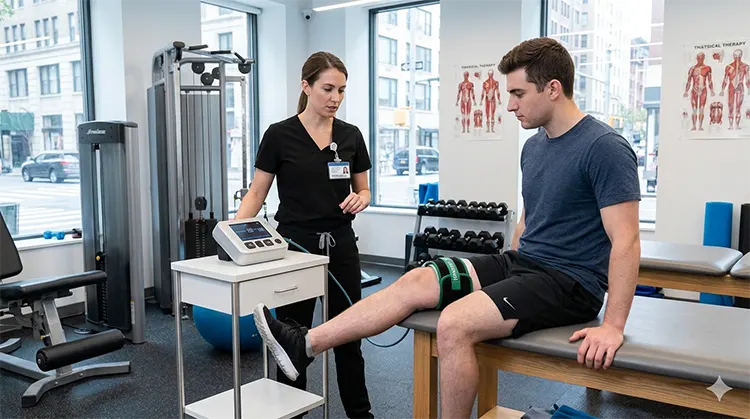
Blood Flow Restriction therapy involves the application of a specialized cuff or wrap to the upper arm or upper leg during exercise. The cuff partially restricts venous blood flow from the muscle while maintaining arterial flow in. This creates a temporary, controlled environment of metabolic stress in the muscle that triggers powerful adaptations typically only seen with heavy resistance training.
The result is significant muscle growth and strength gains using weights as light as 20 to 30 percent of what a person could normally lift, making it safe, effective, and accessible even for those who cannot tolerate high loads due to pain, injury, or post-surgical restrictions.
How BFR Therapy Works
When blood is partially restricted from leaving the muscle during exercise, several important physiological responses occur. Metabolic byproducts accumulate, growth hormone levels surge, and muscle fibers are recruited in ways that mirror the demands of heavy lifting all without placing significant stress on joints, tendons, or healing tissues.
This makes BFR therapy uniquely valuable during the early stages of rehabilitation, when traditional strengthening exercises may be too painful or too risky to perform at the intensities normally required to build strength.
Who Can Benefit from BFR Therapy?
BFR therapy is highly versatile and can be beneficial across a wide range of conditions and patient types, including:
Post-surgical rehabilitation particularly following ACL reconstruction, rotator cuff repair, joint replacement, and other orthopedic procedures. Muscle atrophy and weakness when disuse, immobilization, or injury has led to significant loss of muscle mass. Chronic pain conditions were loading the affected area at normal intensities is not well tolerated. Older adults who need to maintain or rebuild muscle but cannot safely perform high-intensity resistance training. Athletes are looking to enhance performance, accelerate recovery between training sessions, or maintain fitness during injury. Patients with joint pain including knee osteoarthritis and other conditions where heavy loading aggravates symptoms.
What to Expect During a BFR Session
A trained clinician applies a pneumatic cuff to the appropriate limb and inflates it to a personalized pressure based on your limb size and arterial occlusion pressure ensuring the technique is both safe and effective for your body specifically.
You'll then perform low-load exercises such as leg press, knee extensions, bicep curls, or other movements tailored to your rehabilitation goals. Sessions typically involve multiple sets with short rest periods, and the entire BFR component of your visit usually takes 15 to 20 minutes.
Most patients describe a sensation of muscle fatigue and a mild burning feeling during the exercise like what you'd feel during an intense workout followed by a quick recovery once the cuff is removed. Any discomfort resolves rapidly, and patients generally feel well immediately after the session.
Is BFR Therapy Safe?
When administered by a trained clinician, BFR therapy has an excellent safety profile and is supported by a substantial body of research. Before beginning treatment, we conduct thorough screening to ensure BFR is appropriate for you. It is not recommended for individuals with certain cardiovascular conditions, blood clotting disorders, or other contraindications, all of which we carefully evaluate beforehand.
The cuff pressures used are individualized and controlled, never cutting off arterial blood flow entirely. This is not a painful procedure, and it is far safer than attempting to achieve the same muscle-building stimulus through heavy loading during recovery.
The Evidence Behind BFR
Blood Flow Restriction therapy is not a trend it's a well-researched clinical tool with decades of supporting science. It has been adopted by professional sports teams, military rehabilitation programs, and leading orthopedic centers around the world. Study after study has confirmed its ability to increase muscle size and strength, reduce atrophy during recovery, and improve functional outcomes all with minimal joint stress.
Why Choose Us for BFR Therapy
Not all providers offering BFR therapy are equally trained or equipped. Our clinicians are certified in BFR applications and use calibrated pneumatic devices that allow for precise, individualized pressure settings not generic elastic wraps or guesswork.
We integrate BFR into a comprehensive treatment plan designed around your specific goals, condition, and timeline. It is one powerful tool among many we use to help you recover fully and perform at your best.
Frequently Asked Question (FAQ)
Here's an FAQ section for the Blood Flow Restriction Treatment page:
During a BFR session you'll feel a tightness from the cuff and an intense muscle burn and fatigue as you exercise similar to the feeling at the end of a hard workout. This sensation resolves quickly once the cuff is removed. Most patients are surprised by how fatigued the muscle gets with such light weights, which is exactly the intended effect.
The exercise itself produces muscle fatigue and a burning sensation, but it should not be acutely painful. The cuff pressure is individually calibrated so it is firm but tolerable. If anything feels uncomfortable beyond normal exercise effort, we adjust immediately. Patient comfort and safety are always the priority.
Traditional strength training requires lifting at 70 percent or more of your maximum capacity to stimulate meaningful muscle growth. BFR achieves a similar physiological response using loads as light as 20 to 30 percent of your maximum making it possible to build strength even when heavy loading is not safe or tolerable due to pain, injury, or surgical restrictions.
In many cases, BFR can be introduced quite early in the post-surgical rehabilitation process sometimes within the first few weeks precisely because it does not require heavy loading of the healing tissue. The exact timing depends on your surgery type, your surgeon's guidelines, and your individual recovery progress. We coordinate with your surgical team to determine the appropriate starting point.
Many patients notice improvements in muscle endurance and strength within 3 to 4 weeks of consistent BFR training. Measurable changes in muscle size and functional strength typically become more evident over 6 to 8 weeks. Results vary based on your baseline condition, frequency of sessions, and overall treatment plan.
No BFR therapy is a powerful complement to a comprehensive rehabilitation program, not a standalone treatment. We integrate it strategically alongside manual therapy, therapeutic exercise, and other interventions to maximize your overall outcomes.
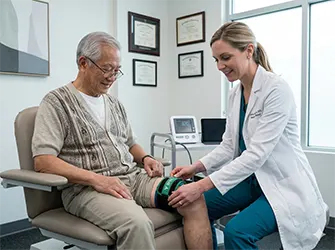
Yes, when properly screened and administered. Older adults are one of the populations that benefit most from BFR therapy, since age-related muscle loss (sarcopenia) can be difficult to address safely with heavy resistance training. BFR offers a way to stimulate meaningful muscle adaptation without placing excessive stress on aging joints and connective tissue.
Yes. BFR is not appropriate for everyone. We screen all patients carefully beforehand. Contraindications may include certain cardiovascular conditions, a history of deep vein thrombosis or blood clotting disorders, active infection in the limb, pregnancy, and certain other medical conditions. Your safety is always evaluated before any BFR protocol begins.
Some mild muscle soreness in the 24 to 48 hours following a session is normal, especially in the beginning like what you'd experience starting any new exercise program. Most patients find soreness manageable and decreasing as their body adapts over the first few sessions.
Occasionally we may recommend a home BFR program for appropriate patients, which requires a proper cuff device. We will guide you on safe equipment options and teach you the correct protocol before transitioning any exercises to a home setting. Unsupervised use of makeshift alternatives like elastic bands is not recommended and can be unsafe.
The best way to find out is to schedule an evaluation with one of our clinicians. We'll review your medical history, assess your current condition and strength levels, and determine whether BFR is a good fit for your rehabilitation goals.
Simply contact our office to schedule your initial evaluation. We'll walk you through everything, answer any remaining questions, and get you started on a plan designed to help you recover as fully and efficiently as possible.


